Center for Cognitive Impact
LTD Liability Co.
Rewiring Learning for a Cognitive Future

The Origin of Designing Learning™ & Cognitive Impact™
A Story of Inquiry, Collaboration, Iterative Refinement, and the Birth of a New Theory of Learning
Cognitive Impact™ and the Designing Learning Model™ were not born from a conference table, a policy mandate, or a theoretical abstraction.
They were born in the field, in the crucible of real classrooms, through thousands of hours of inquiry, observation, iteration, and transformation.
The Foundational Spark — Klaus’s Conceptual Groundwork
The earliest spark originated with Maryann Klaus, whose groundbreaking investigation into Learned Helplessness revealed a truth long overlooked:
students weren’t failing because they lacked ability—they were failing because the system had stopped teaching them how to think.
Klaus recognized the deeper failure – schools and educators had stopped learning. Instruction became delivery, not design, and compliance overshadowed cognition.
Her solution emerged from four intellectual frameworks:
- Design Thinking (Simon, Brown, Kelley): learning must be designed, not delivered.
- Intellectual Standards (Paul & Elder): thinking must be made visible, measurable, and improvable.
- Nature of Feedback (Hattie, Wiggins): feedback must accelerate cognition, not evaluate behavior.
- Metacognition (Flavell, Brown, Campione, Zimmerman): learners must be taught to monitor and direct their own thinking.
These were not added ideas—they were foundational conditions for a new paradigm.
Designing the Principles — From Insight to Framework
During Years 1-2 of the study, Klaus and Gonzalez engaged in over 5,000 documented hours of:
- discovery
- exploration
- observation
- dialogue
- reflection
- self-reflection
- collaborative redesign
- field testing
It was in this iterative crucible that the Designing Learning Model™ Principles were created.
Dr. Gonzalez authored the full set of principles, designing a mastery architecture that reflected the empirical realities of instruction, cognition, and continuous improvement cycles. Klaus co-created Principles 2 and 8, infusing them with her conceptual grounding in constructivist theory, design thinking, intellectual standards, systems thinking, and feedback systems.
Each principle emerged from real need—patterns seen across classrooms, student reasoning samples, facilitator habits, and systemic gaps illuminated through research and empirical findings.
The principles became more than statements.
They became a design language for cognition.
Years 3–4 — Iteration, Revelation, and the Discovery of the Gaps
During Year 3 and Year 4 of field implementation, new insights emerged.
Despite the power of the principles, several gaps appeared:
- Facilitators needed deeper understanding of how to operationalize each principle.
- The principles required clearer cognitive foundations, not just instructional ones.
- Stakeholders needed ways to see, measure, and name the cognitive work.
- Identity, reflection, and metacognition needed to be woven explicitly into cognitive design.
- The system needed a way to ensure fidelity without rigidity—a hallmark of true iterative design.
These gaps did not weaken the model—they clarified the next evolution. Cognitive Impact identifies these gaps as discoveries of a maturing and reflective practice. The process of uncovering gaps is actually part of the model’s strength, showcasing its adaptability and continuous improvement. These insights foster a collaborative approach, where facilitators and stakeholders help co-create the next iteration of the model, ensuring it remains dynamic and responsive.
Evidence of Efficacy — Learning Begins When Thinking Begins
The Year 1 Cohort (composed of DLM/Cognitive Impact participants) produced measurable, unprecedented results:
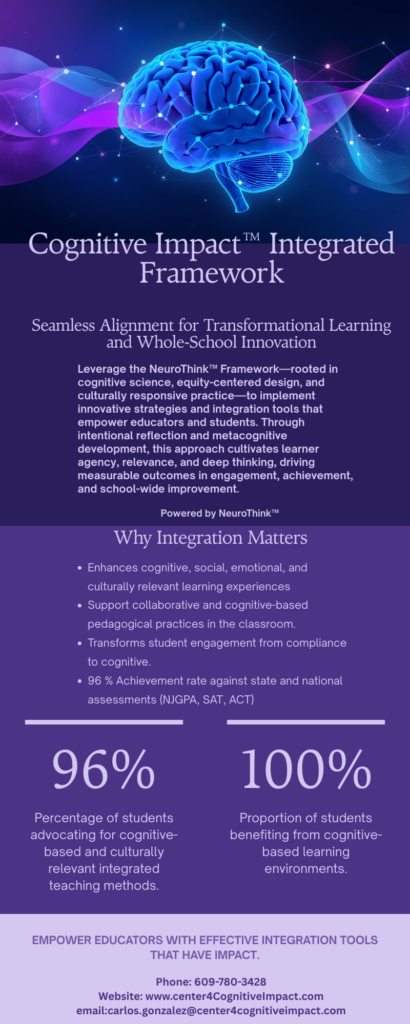
- 96% NJGPA proficiency among high school seniors (n=121) (NJGPA Achievement Scores – New Jersey Department of Education)
- 38 out of 160 Cognitive Impact students met or exceeded SAT ELA benchmarks (2024-2025)
- dramatic increases in reasoning, writing, metacognition, and transfer
- enhanced student agency and ownership
- exemplified culturally responsive and relevancy-based learning
- strengthened facilitator clarity and instructional rigor for continuous improvement
These results validated that instruction does not create learning—cognition does. And the model successfully activated it.
Cognitive Impact™ — Deepening, Extending, and Illuminating the Principles
As a direct response to these gaps, Cognitive Impact™ emerged as the second-generation paradigm, designed to:
- deepen the neuroscience behind the principles
- expand identity, belonging, and cultural context
- anchor metacognition as a design element
- Provide transferable cognitive-based tools to support engagement
- give facilitators ways to make thinking measurable
- support district leaders in building cognitive learning organizations.
- help students see, regulate, and transfer their thinking beyond school and into life.
Cognitive Impact™ did not replace Designing Learning™.
It expanded it. It gave the principles depth, breadth, and cognitive legitimacy. While Designing Learning set the stage, the Cognitive Impact framework added depth, breadth, and evidence-based legitimacy, ensuring that those original principles were not just implemented in situated contexts of urban classrooms but truly brought to life in a cognitively rich way.
In essence, the Cognitive Impact framework stands on the solid foundation of Designing Learning principles and then extends it into a comprehensive system of cognitive growth. By integrating the Theory of Cognitive Design as our guiding framework, we adopt a holistic approach that brings established cognitive theories into a coherent, intentional system. This framework ensures that each layer of intellectual development is purposefully designed and connected, transforming research-based principles into lived cognitive experiences for learners.
Through direct field experience as a facilitator of instruction, I gathered the insights that became the missing cognitive layers—eventually forming the NeuroThink™ Principles and the Cognitive Impact™ Framework.
When we make thinking the curriculum, everything changes.
– Dr. Carlos Enrique Gonzalez

A New Theory of Learning for a New Era of Education
Cognitive Impact™ delivers a breakthrough approach to education by aligning teaching with how the brain actually learns. Founded on the Designing Learning Model and strengthened through five years of rigorous field research, we bring together neuroscience, identity, instructional design, and reflective analytics to create learning systems that build thinkers—not just task-doers. Districts, schools, and educators trust us because our work is evidence-based, results-driven, and proven to transform learning at scale. With Cognitive Impact™, you’re not adopting another initiative—you’re stepping into a new era of education grounded in science, clarity, and human potential.
THE EMERGENCE OF A NEW THEORY: THE THEORY OF COGNITIVE DESIGN™
A theoretical framework that asserts learning is produced by intentionally designed cognitive, neurological, reflective, and identity-driven processes—activated through iterative instructional design, collaborative inquiry, and metacognitive leadership.
Cognitive Impact™ is not a program — it is a paradigm.
Its strength comes from the convergence of research, field-tested practice, and continuous collaborative inquiry.
This page outlines the theoretical pillars that ground NeuroThink™ and the broader Framework for Cognitive Impact™.
Together, these theories culminate in a new educational framework:
The Theory of Cognitive Design™.
The Six Theoretical Pillars
Pillar 1: Transformational Learning Theory
Jack Mezirow (1991, 2000)
Transformational Learning states that deep learning occurs when learners experience dissonance, question assumptions, reconstruct meaning, and activate new perspectives.
How Cognitive Impact™ applies it:
- Productive struggle activates cognitive restructuring
- Reflection is built into every cycle of learning
- Identity development enhances meaning-making
- Students transform how they think, not just what they know
Pillar 2: Cognitive Leadership Theory
Argyris & Schön (1978), Leithwood (2004), Senge (1990)
Cognitive Leadership asserts that systems improve when leaders model reflective practice, inquiry, double-loop learning, and meaning-making. Cognitive leadership theory enriches the Theory of Cognitive Design by positioning leaders as architects of cognitive culture. Leaders use the principles of cognitive design not just as tools for instruction, but as a way to lead and transform the entire learning environment.
How Cognitive Impact™ applies it:
- Principals lead by thinking, not by managing tasks
- District leaders use cognitive data, not compliance metrics
- Cognitive Impact Rounds & reflection cycles form a leadership learning system
Pillar 3: Neuroscience of Learning
Immordino-Yang (2015); Sousa (2017)
Neuroscience shows learning occurs when neural networks activate, struggle, consolidate, and connect to identity and emotion. By incorporating insights from the neuroscience of learning, the Theory of Cognitive Design isn’t just a conceptual framework – it’s a brain-based approach that leverages how our minds naturally learn and adapt. This neuroscientific foundation ensures that every cognitive strategy we use is aligned with the way the brain works best.
How Cognitive Impact™ applies it:
- NeuroThink™ aligns instruction with neural patterns that support cognitive growth
- Cognitive Activation Maps™ mirror how the brain sequences new learning in situated contexts or materials
- Identity shapes attention and memory
By situating learning in meaningful contexts and relevancy-based tools that naturally draw attention and shape memory, we ensure that the cognitive design isn’t just theory – its something that works in harmony with how our brain learns best.
Pillar 4: Metacognition & Self-Regulation
Flavell (1979); Zimmerman (2002); Brown (1987) Paul and Elder (2011)
Metacognition increases mastery by helping learners monitor, evaluate, and direct their own thinking. Alongside intellectual standards, we operationalize metacognition through reflective questioning routines and thinking journals alongside concepts, topics, theories, and real-life. Structured metacognitive designs help students evaluate not only the clarity and accuracy of their work but also how effectively they manage their own learning strategies.
How Cognitive Impact™ applies it:
- Daily NeuroThink™ prompts tied to intellectual standards
- Reflection as a design principle
- Visible Thinking routines scaled across content areas
- Collaborative inquiry, reciprocal and reflective feedback dialogue
- Social learning and collaborative reflection
Pillar 5: Identity & Sociocultural Cognition
Gee (2008); Nasir (2012)
Learning accelerates when connected to identity, relevance, culture, and purpose from real-life experiences to the content. This is why culture and content matter. Learning is deeply personal; by operationalizing identity and sociocultural cognition, we ensure that learning is culturally relevant and personally meaningful, giving learners a sense of purpose.
How Cognitive Impact™ applies it:
- Identity-driven reasoning routines serve as an infrastructure for metacognition
- Transfer Pathways tied to personal experience
- Every cognitive routine is both personally relevant and culturally meaningful.
- A system where thinking is shaped by who learners are becoming
Pillar 6: deep learning & Cognitive Design
Simon (1996); Wiggins & McTighe (2005) Rose & Meyer (2002) The Learning Sciences
Deep learning emerges from intentional design, not from coverage or pacing. Beyond design thinking, we draw on backward design, Universal Design for Learning, and the Learning Science to create flexible, inclusive, and cognitively rich learning experiences. By starting with clear goals and evidence-based insights, we ensure that every instructional choice is aligned with how people learn best.
How Cognitive Impact™ applies it:
- DLM™ Principles offer a structural blueprint
- Tasks are redesigned through cognitive demand
- Feedback accelerates reasoning and transfer
- Weaving cognitive strategies and reflective practices into every layer of instructional design
- Ensure that thinking is at the heart of the curriculum
The Emergence of Cognitive Impact™
By Year 3 and Year 4 of implementation, new gaps emerged: educators needed deeper cognitive foundations, clearer operationalization, and tools that aligned instruction with cognitive leadership, neural, reasoning, and identity-based processes. Cognitive Impact™ was developed to deepen, operationalize, and extend the DLM™ Principles into a complete cognitive framework for modern schooling.
What This Means for Schools
When theory, design, and practice converge, schools stop reacting and start transforming. The Theory of Cognitive Design™ provides the architecture, language, and tools to build educational systems where thinking is the curriculum, learning is iterative, and achievement naturally follows.
Resulting outcomes include:
- 96% NJGPA proficiency (118/121 students)
- (38/121) SAT benchmark achievers
- Measurable gains in reasoning, writing, and transfer
- Reduction in learned helplessness
- Schoolwide instructional coherence
Rewiring Learning Through the Eight Principles of Cognitive Impact™
The Eight Principles of Cognitive Impact™ redefine what it means to learn by aligning teaching with the brain’s natural pathways for making meaning, building understanding, and developing reasoning. Each principle reveals a core cognitive function—awareness, struggle, meaning-making, identity, reflection, culture, iteration, and advanced thinking—that collectively form the architecture of deep learning. Instead of relying on traditional methods that focus on coverage or task completion, NeuroThink™ shifts the focus to how thinking actually develops. When teachers intentionally design instruction around these principles, students not only perform better—they become stronger, more independent thinkers who understand their own learning processes.
Rewiring learning begins when schools embrace these principles as the foundation for instructional design, leadership decisions, and assessment practices. The Cognitive Impact™ framework helps educators diagnose cognitive needs, activate neural pathways, and design learning that strengthens reasoning, identity, and agency. These principles don’t add more work to teachers’ plates; they bring clarity and coherence to the work they already do, transforming classrooms into environments where thinking thrives.
That’s why Cognitive Impact™ represents a true new learning theory—one that unifies instruction, cognition, and identity into a single, powerful system. It’s not theoretical; it’s field-tested. In one urban school district, this framework magnified results in student thinking, writing, engagement, and performance by activating the very cognitive processes that drive lasting learning. When instruction is designed through the science of how minds grow, the results aren’t incremental—they’re transformative.
COGNITIVE IMPACT™ PRINCIPLES
“WHY THIS MATTERS”
The Eight Cognitive Impact™ Principles represent the core of how learning actually unfolds in the brain. These principles take complex research from neuroscience, cognitive psychology, identity theory, and instructional design and translate it into clear, actionable guidance for educators. They help us understand why students think the way they do, what supports or limits their learning, and how schools can design experiences that develop stronger, more confident thinkers.
Each principle highlights a specific cognitive force—from awareness and struggle to reflection and identity—that shapes how students understand, reason, and grow. Together, they form a cohesive learning architecture that empowers teachers to design instruction with purpose, leaders to build coherent systems, and students to take ownership of their learning. By using these principles, schools move beyond task completion and shift toward thinking-centered learning that is meaningful, equitable, and transformative.
Awareness Precedes Change™
Cognitive Function: Metacognition
Description: Learners must notice their thinking before they can refine it.
Sample Classroom Application: Make thinking visible through routines, modeling, and iterative reflection.
Why This Matters:
You can’t upgrade a mind you don’t even know you’re using. When students become aware of their thinking, they unlock the superpower of changing it. Awareness flips the switch from autopilot to intentional growth.
Dissonance Catalyzes Growth™
Cognitive Function: Neural activation, schema disruption
Description: Cognitive struggle triggers the brain to reorganize and deepen understanding.
Sample Classroom Application: Use productive challenge, inquiry, and reasoning tasks—not over-scaffolding.
Why This Matters:
Growth isn’t born from comfort; it erupts from the beautiful chaos of “Wait… what?” Dissonance is the brain’s wake-up call — the spark that rewires neurons and turns confusion into clarity.
Meaning Is Constructed™
Cognitive Function: Schema construction
Description: Learners build understanding by connecting ideas to prior knowledge and experience.
Sample Classroom Application: Use tasks and questions that push students to interpret, connect, and explain.
Why This Matters:
Learning doesn’t magically appear — students build it, brick by cognitive brick. When they construct meaning, they own the learning. Ownership is power, and power travels far beyond the lesson.
THE NEUROTHINK™ PRINCIPLES PROVIDE A COMPLETE LEARNING ARCHITECTURE
They explain how the mind learns, how instruction activates cognition, and how schools can transform learning at scale.
Identity & Learning Are Interwoven™
Cognitive Function: Relevance-making, emotional safety
Description: Cognitive Learning is shaped by the social, emotional, and cultural environment.
Sample Classroom Application: Design culturally connected experiences and maintain psychologically safe classrooms.
Why This Matters:
The brain doesn’t learn when it feels unsafe, unseen, or uninspired. Culture shapes cognition. When students feel they belong, their minds open and their potential ignites.
Reflection Is a Design Principle™
Cognitive Function: Neural strengthening and reconsolidation
Description: Learning develops through cycles of practice, feedback, and revision.
Sample Classroom Application: Prioritize drafts, feedback loops, conferencing, and cognitive return.
Why This Matters:
Mastery isn’t a moment — it’s a cycle. Each revision strengthens neural pathways, transforming temporary understanding into durable intelligence. Growth is a loop, not a line.
Culture & Context Matter™
Cognitive Function: Relevance-making, emotional regulation, and engagement
Description: Learning is shaped by the cultural, social, and contextual conditions in which thinking occurs. Students interpret and process information through their identities, lived experiences, and sense of belonging.tional, and cultural environment.
Sample Classroom Application: Design learning experiences that connect content to students’ cultural contexts and real-world experiences, while intentionally establishing psychologically safe conditions that support intellectual risk-taking. content alignment, and open inquiry..
Why This Matters:
When students experience relevance and belonging, cognitive engagement increases—because the brain, like a person, doesn’t do its best work when it’s busy protecting itself.
If learning feels like a room where you don’t belong, your mind stays at the door. But when students feel seen, safe, and connected, their attention shows up, their persistence kicks in, and they’re far more willing to wrestle with complex ideas.
The Eight Cognitive Impact™ Principles don’t just explain how learning works—they provide a blueprint for transforming classrooms, empowering educators, and elevating every learner’s potential. When schools design learning through the lens of cognition, achievement rises, engagement deepens, and students begin to see themselves as capable thinkers with unlimited possibility.
Growth Is Iterative & Recursive™
Cognitive Function: Neural strengthening and reconsolidation
Description: Learning develops through cycles of practice, feedback, and iterative revision.
Classroom Application: Prioritize drafts, feedback loops, conferencing, and cognitive return.
Why This Matters:
Mastery isn’t a moment — it’s a cycle. Each revision strengthens neural pathways, transforming temporary understanding into durable intelligence. Growth is a loop, not a line.
Thinking Is the Curriculum™
Cognitive Function: Advanced reasoning, transfer
Description: Deep learning happens when students reason, analyze, evaluate, and create through iterative refinement cycles.
Classroom Application: Make thinking the goal of every lesson—not task completion.
Why This Matters:
Tasks come and go. Thinking stays for life. When schools teach students how to think, not just what to do, they unlock the kind of learning that travels across subjects, careers, and generations.
Now is the moment to reimagine what learning can be.
If your district is ready to move beyond initiatives, beyond compliance, and beyond traditional models of teaching, Cognitive Impact™ offers the science, tools, and support to make lasting transformation possible.
LETS BUILD THINKING-CENTERED SCHOOLS TOGETHER.
👉 Explore the Framework
👉 Request a District Consultation
👉 Bring Cognitive Impact™ to Your Classrooms.
Our Services
We partner with schools to create thinking-centered systems where learners become aware, reflective, and cognitively empowered. Our five-year research yielded a 96% NJGPA proficiency achievement rate—because when thinking improves, everything improves
Our Cognitive Impact™ service pillars provide a comprehensive approach to strengthening learning, cognitive leadership, and cultivating cognitive-based cultures within and across educational systems.
Facilitator Professional Learning & Coaching
This pillar strengthens instructional expertise by immersing educators in the Cognitive Impact™ Pathways and Cognitive Impact™ Principles—a system proven to deepen thinking, sharpen reasoning, deepen understanding, and elevate learning outcomes.
Through practical application, educators learn to design instruction that activates cognition rather than simply delivering content. They engage by cultivating thinking dispositions, the use of visible thinking routines, metacognitive practices, and standards-aligned strategies that transform lessons into meaningful, intellectually rich experiences.
Every component is personalized to the school’s data, context, and goals, ensuring educators gain:
- Instructional clarity grounded in cognitive science aligned to the standards
- Intentional design skills that activate cognitive pathways for learners
- Metacognitive tools that lead toward learner efficacy
- Deep understanding of how to move learners from performance to insight
This pillar equips educators to teach with purpose, precision, and the confidence to create classrooms where thinking—not compliance—drives achievement.
Cognitive Leadership Development & Coaching
This pillar empowers superintendents and principals to lead with clarity, purpose, and cognitive precision. Through deep coaching anchored in the Cognitive Impact™ Framework, leaders learn to design and sustain thinking-centered school cultures where reflection, relevance, and evidence drive every decision.
Leaders develop decision intelligence—the ability to interpret evidence, recognize cognitive patterns in teaching and learning, and guide facilitators through meaningful improvement cycles. Coaching emphasizes building learned efficacy, strengthening feedback systems, and aligning instructional moves to the cognitive processes that drive deep understanding and long-term growth.
The result is a cognitive leadership identity grounded in:
- Reflective and Iterative insight
- Instructional and cognitive coherence
- Strategic clarity
- Purpose-driven decision-making supported by evidence-based practices
- The ability to cultivate thinking schools, not just manage operations
This pillar transforms leaders into designers of culture—capable of creating schools where thinking thrives, staff grows, and every learner benefits from a system grounded in cognitive equity.
Reflective Analytics Model™
The Reflective Analytics Model™ (RAM) transforms data from static numbers into dynamic stories of thinking. Educators learn to interpret evidence through a cognitive lens—examining not only what students produced, but how their minds will transfer through designed cognitive-based learning.
Using state- and national-standards–aligned dashboards across all content areas, teams analyze standardized assessments, student work artifacts, evidence patterns, and cognitive gaps that traditional reporting systems overlook. The result is a clear, multidimensional understanding of how learners reason, interpret, analyze, and construct meaning within the standards themselves.
Grounded in the Cognitive Impact™ Principles, RAM reveals:
- Awareness Precedes Change → Where learners understand their cognitive moves—and where misunderstanding begins.
- Dissonance Catalyzes Growth → Which standards-aligned tasks activated productive struggle and which inhibited neural engagement.
- Meaning Is Constructed → How students connect standards-based content to prior knowledge, culture, and experience and how to design it for them.
- Reflection Is a Design Principle → Where standards-based reflection deepened understanding and where it was missing.
- Growth Is Iterative → How thinking evolves across cycles of practice tied to sequential standards.
Through iterative reflective spirals, educators develop precise insight into student needs and refine instruction with clarity and intention. RAM shifts schools from surface-level data compliance to cognitive clarity, where evidence becomes a catalyst for transformation rather than judgment.
Most importantly, RAM ensures that every analysis—whether in ELA, math, science, social studies, CTE, or the arts—remains tightly aligned to:
- State learning standards
- National benchmarks
- Content-area performance expectations
- Disciplinary cognitive-based practices
Curriculum & Instructional Design — Thinking Is the Curriculum™
The heart of this pillar is simple and transformative: curriculum is not content—curriculum is cognition.
This service helps schools design curriculum maps and instructional units that align state and national standards with cognitive activation points for and of learning. Instead of pacing guides that march through coverage, educators build cognitive-based tasks, inquiry-driven experiences, and culturally and real-life embedded pathways that activate cognition and deepen understanding across all content areas.
Curriculum is redesigned as a cognitive blueprint, where standards come alive through:
- Thinking dispositions that cultivate intellectual courage, cognitive flexibility, disciplined reasoning, and reflective judgment—strengthening the mental architecture learners need to analyze, interpret, and construct meaning across all content areas.
- NeuroThink™ Principles that anchor instructional decisions
- Intellectual Standards–aligned rubrics that bring clarity, precision, and depth to student thinking with the content.
- Metacognitive routines that make understanding visible
- Multi-content integration that accelerates transfer and conceptual mastery of the standards
- Relevance- and identity-driven design that increases engagement, real-life experiences, and purpose
Educators learn to design learning that transcends standards—
rewiring understanding, strengthening “how students think”, and building the stamina, adaptability, and intellectual courage students need for long-term success.
Curriculum becomes:
- A system for activating cognition
- A pathway for constructing meaning
- A map for inquiry and exploration
- A bridge connecting identity, context, and content – since they all matter!
- A catalyst for transfer and deep learning
In short:
Thinking Isn’t an Add-On. Thinking is the Curriculum™
Capturing and Evaluating Learning Feedback Systems
This pillar equips schools to build feedback operating systems where learning is continuously strengthened through clarity, reflection, and cognitive precision. Rather than treating assessment as an endpoint, we support schools in designing standards-based, thinking-centered feedback systems aligned to Intellectual Standards and powerful cognitive routines.
Educators learn to provide feedback that does more than correct — it activates cognition.
Grounded in the NeuroThink™ Principles, this pillar helps schools develop systems where:
- Awareness Precedes Change → Learners recognize their thinking patterns and understand exactly what and how to improve.
- Dissonance Catalyzes Growth → Feedback intentionally challenges misconceptions, pushing learners into productive inquiries around cognitive struggle.
- Meaning Is Constructed → Students interpret feedback using Intellectual Standards, making sense of expectations with clarity and purpose.
- Reflection Is a Design Principle → Feedback cycles incorporate structured reflection that strengthens reasoning and deepens understanding.
- Growth Is Iterative → Learners track their thinking across cycles, seeing evidence of cognitive growth—not just task completion.
Schools receive support to build:
- Standards-aligned feedback rubrics tied to Intellectual Standards across content areas.
- Cognitive-based formative assessment routines are not quick checks for correctness—they are diagnostic windows into thinking.
- When supported through the NeuroThink™ Reflective Growth Series™, these routines help both students and adults develop the awareness, insight, and precision needed to strengthen reasoning and deepen understanding.
- Student-facing feedback protocols that build agency and metacognition
- Teacher feedback habits that strengthen reasoning, not just performance
- Reflection spirals for monitoring progress with intention and insight
- Systems that promote efficacy, ownership, and clarity of expectations
When feedback becomes cognitive—not corrective—students don’t just improve their work.
They improve their thinking, which transforms every future learning experience.
In short:
Feedback becomes the engine of learning, reflection becomes the accelerator, and cognition becomes the destination toward mastery.
Culture of Thinking, Identity & Belonging™
This pillar helps schools design environments where identity, emotional safety, and cognitive challenge work together to fuel deep learning. Grounded in neuroscience and the NeuroThink™ Principles, this pillar transforms classrooms into spaces where students feel seen, valued, and intellectually engaged—conditions the brain requires for meaningful growth.
Educators learn to create learning cultures that:
- Affirm student identity as a catalyst for cognitive engagement
- Promote emotional safety so learners are willing to take intellectual risks
- Integrate student voice, agency, and perspective into daily routines
- Strengthen belonging, which increases neural readiness for reasoning
- Use reflection to deepen self-awareness and metacognitive control
Anchored in the principles:
- Identity & Learning Are Interwoven → Students learn best when who they are is honored in what they learn.
- Culture & Context Matter → The brain responds to the environment before it responds to the instruction.
- Dissonance Catalyzes Growth → Safe spaces allow students to embrace challenge without fear.
- Reflection Is a Design Principle → Learners build insight and belonging through guided self-awareness.
The goal is not simply a positive climate—it is a thinking culture where:
- belonging fuels engagement
- safety fuels risk-taking
- identity fuels meaning
- cognition fuels achievement
In these classrooms, thinking, belonging, and growth don’t just coexist— they reinforce one another to create the conditions where every learner can thrive.
NeuroThink™
From Standards to Synapses—Designing Learning That Thinks, Feels, and Grows.
NeuroThink™ partners with district schools to redesign learning from the inside out—activating the full architecture of student growth: cognitive, emotional, intellectual, and ethical.
We equip school systems with neuroscience-aligned tools, coaching, and strategic frameworks that turn standards into meaningful, transformational learning. Our services are tailored to meet the specific needs of districts, schools, and leadership teams committed to deeper thinking, equity, and authentic student growth.
District Services Include:
- Strategic Vision Alignment: Embed the NeuroThink™ Framework into district goals, instructional models, and leadership pathways to ensure cognitive and equity-centered coherence across schools.
- The Standards Analyzer: Audit curriculum and instruction for depth, cognitive rigor, and identity relevance—moving beyond compliance toward transformation.
- Professional Learning Plans: Scaffolded PD rooted in cognitive science, SEL integration, and instructional equity—designed for superintendents, principals, and teacher teams.
- Disposition Profiler System: Track the development of students’ thinking dispositions, executive function, and SEL growth with actionable insight dashboards.
- Instructional Leadership Tools: cognitive round templates, reflection protocols, and coaching systems aligned with intellectual standards and NJGPA benchmarks.
- School-Wide Implementation Support: Strategic coaching and design for system-wide implementation of the NeuroThink™ Spiral Model, Cognitive Lift™, and Neuro-Mapping Insight tools.
Through partnership, we help districts move from performance pressure to purposeful growth, empowering educators and students to think deeply, act ethically, and learn for life.
What Sets Us Apart
A cognitive-centered approach that builds thinking at every level.
We combine neuroscience, cognitive and reflective practice, and evidence-based design to create lasting instructional growth.
NeuroThink™ Reflective Growth Series™
The NeuroThink™ Reflective Growth Series™ is a transformational professional learning pathway designed to strengthen how educators think, reflect, and make instructional decisions. Rooted in neuroscience and the Eight NeuroThink™ Principles, this series develops the metacognitive habits, reasoning skills, and cognitive clarity educators need to design deep learning experiences.
Four-Stage Reflective Growth Process™
A Cognitive Impact™ Pathway for Transforming Teaching, Thinking, and Learning
The Four-Stage Reflective Growth Process™ (Seeing & Thinking Clearly, Cognitive Activation, Elevated Thinking, and Iterative Growth Cycles) turns teaching into cognitive designs, cultivating classrooms into cultures of thinking, and schools into systems where growth is not accidental—
it is engineered through awareness, intentional actions, elevation, and iteration. (1-3 Year Engagement)
NeuroThink™ Six-Domain Transformational Model™
Developed from five years of field research—including the landmark 96% NJGPA achievement rate in 2025—the NeuroThink™ Six-Domain Transformation Model™ provides a comprehensive, research-aligned structure for transforming teaching, learning, and leadership through a cognitive-equity leadership series.
Powered by NeuroThink, Neuroscience, and the Eight Cognitive Impact™ Principles, this model helps schools build thinking-centered ecosystems where instruction is intentional, evidence is meaningful, leadership is coherent, and student reasoning becomes visible across disciplines.
Ready to strengthen thinking
and learning in your organization?
We’d love to support your next step in professional learning and cognitive development.
Phone: 609-215-7778
Email: admin@center4cognitiveimpact.com
Business Hours: Monday through Friday, 9am – 5pm